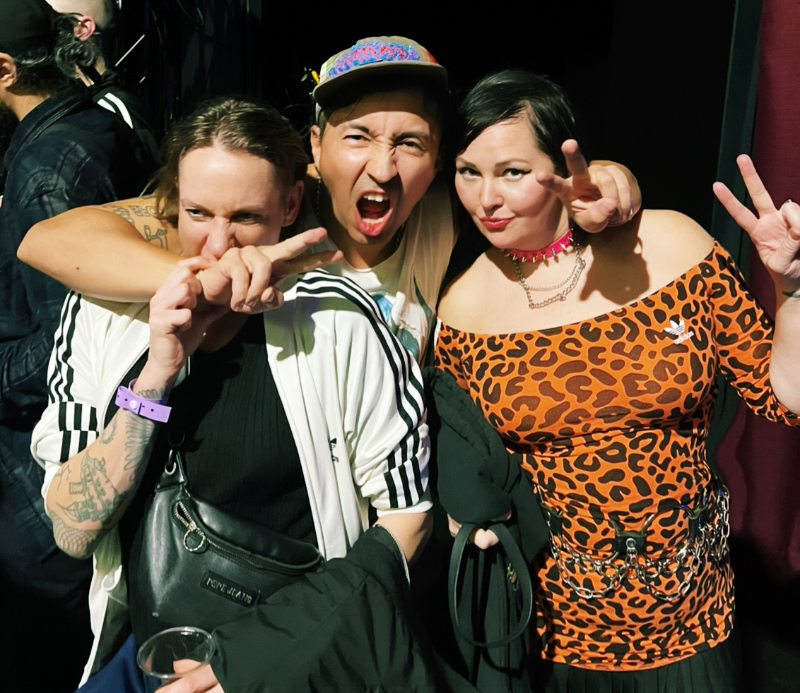
Journalist, DJ and hardcore raver Vivian Host speaks to Dance or Die author Holly Dicker about their respective rave upbringings in LA/NYC versus Manchester/Berlin/Rotterdam in the first instalment of a four-part Rave to the Grave takeover dedicated to the untold histories of hardcore!
Read an edited extract of the conversation from the podcast, featuring extended interviews with London pirate radio legend Warlock, Dutch free party linchpin Siuli Ko, and LA’s own junglist Baseck happening at ravetothegrave.org over the next few weeks.
VIVIAN: Tell me about the different people we have interviewed for the series, and why you think they are important.
HOLLY: Warlock has been part of the London pirate radio and free party scene from the beginning, and is still involved to this day, still on community radio, still playing hardcore. He was one of the first people I interviewed, and he provided the quote I have kind of built the entire book around, which is: hardcore, means many things to many people, and they’re all correct.
Not only has he been part of this scene as a DJ, he’s also got loads of archive material and is a big zine collector. He’s kept every single rave flyer – and he’s been part of a lot of raves. He was an absolute treasure trove of knowledge and enthusiasm, and he helped launch the book in London.
Then there’s Baseck, another artist I met through PRSPCT. Unfortunately, we connected a bit too late in the process to fully contextualise his story – the book was already three years overdue by that point – and I didn’t get enough time to tap into the rich LA history. I guess I should have called you to get all the stories…
VIVIAN: He sent me a flyer of a party his brother threw and I was booked; it said Star Eyes, Lady Junglist. We didn’t meet back then. We actually met relatively recently. I think the whole Los Angeles, California, and also the Midwest chapters of Hardcore definitely deserve a book…
HOLLY: And then there’s Siuli Ko, linchpin in the Dutch free party scene. She’s the missing piece of the Spiral Tribe story. Without her setting up a record distribution network, a lot of us would not have heard of Spiral Tribe. She was living in the Blauwe Aanslag at the time, which deserves a whole other book, where she connected with Jan Duivenvoorden and Bunker Records to throw the infamous Acid Planet raves in the basement of this squatted social centre in the middle of the Hague, a city in the Netherlands, which notoriously gets shut out of the Amsterdam-Rotterdam legacy, but was very important nevertheless.
VIVIAN: Hardcore means many things to many people, as one finds out in the book. So what are we talking about in this podcast?
HOLLY: If we could not talk about the music element of it, that would be the best way to get past a lot of angry emails about what is and isn’t hardcore. Hardcore is a feeling, an attitude, and a way of life. Musically, it means a lot of different things, and it has changed dramatically over the last thirty (or forty) years.
But what I have noticed from speaking to a wide range of people is their passion (for whatever niche they’re into) is the thing that’s the same, which unites us all in the dance. Even if we’re dancing to different things and listening to different music, in the end, we’re all the same kinds of people.
We’re all outsiders, living on the fringes of society and not really accepted in some way, so we found our own tribe, our acceptance, in whatever weird, harsh, noisy space that we’re into.
VIVIAN: What got you into electronic music or raves?
HOLLY: I grew up in many different countries, so by the time I was eight, I’d already lived in Australia and Singapore and been to I don’t know how many different schools. When I came back to England, I was instantly an outsider, and I think I’ve just stayed there. It wasn’t until much later, eighteen, I started going to my first parties and I found acceptance in my dancefloor family. I was fortunate enough to be in the UK at the time of drum & bass exploding.
The Fabio & Grooverider Drum & Bass Arena CD was my route into dance music, and going to art school in Manchester in the mid-00s, where there was a really vibrant club scene and buzzing free party movement. Some of my first rave experiences were listening to drum & bass and dubstep sound systems (shout out to G.A.S.H. and Daylite Robbery) set up in WWII bunkers and castles and warehouses on the outskirts of Manchester. And being fucking terrified. How old were you when you started raving?
VIVIAN: I was thirteen. The first rave I went to was a break-in in the basement of a public storage building here in LA and it was honestly a little bit scary. I just felt out of my depth. There were definitely people offering me drugs. It was very dark because it was just a break in with one strobe light. It wasn’t Castlemorton or what I was seeing in NME and Melody Maker and these pictures of giant raves.
But then I went to a Prodigy concert and this rave at Knott’s Berry Farm, which is a huge amusement park here, called K-Rave, and between those two things I discovered the rave that I was looking for and the music and then it became a full obsession… But the cops are a real presence here. When you grow up with police showing up in riot gear with batons, tear gas, machine guns, you kind of internalise that…
HOLLY: Have you always only known a heavy police presence in LA?
VIVAN: In 1991, Rodney King was pulled out of his truck and beaten brutally by police officers. And it was caught on video, which basically kicked off the LA riots. I started going to raves in 1991/92 and so the LA riots were a really crazy thing to live through. It was on TV all day long, and in the streets all day long, the cops doing full military cosplay, everywhere. So even if that wasn’t directed towards raves, it was still in our consciousness that the cops will show up like this if they want to. I have been to many parties where the riot cops showed up. They even showed up at my high school.
I think that this, in part, is a reason why hardcore music is so prevalent in Los Angeles, in the underground, and makes so much sense to people here, because this can be a very aggressive place to be at times. It’s super urban, super grimy. The aesthetics of hardcore and the need to get out that level of aggressive energy, I think, really resonates with LA people. Also a lot of early hardcore was sampling gangster rap – that’s our classics. NWA, Ice Cube, Snoop Dogg, Dr Dre, everybody knows the words to all those songs because they’re on the radio all the time.
HOLLY: This is essentially where the book begins: with two white Frankfurt kids doing hardcore hip hop, but also listening to Detroit techno and then doing their own thing with it. This is also the only point that nearly all of us can agree on, that the hardcore timeline begins with Marc Acardipane and PCP.
VIVIAN: Fun fact: the first record on vinyl I ever bought was one of his records under the alias Ace The Space, called 9 Is The Classic, and this samples this old hip hop acapella The 900 Number (by The 45 King). It just speaks to how important that sound was in LA, that I was going to raves, and the first record I wanted to buy was this record from Frankfurt, Germany.
Did everybody you interviewed for the book pretty much agree that it was the PCP Frankfurt gang that started hardcore?
HOLLY: This is universally the one thing that most of us can agree on, yes. The first Dutch gabber record (Amsterdam Waar Lech Dat Dan? by Euromasters) samples We Have Arrived by Marc Acardipane as Mescalinum United. And the first PCP record (Into Mekong Center) was released in 1989. After that, it’s open to interpretation… The only way I could work through all of this was to find the one or two characters who looped it all together.
Brooklyn’s Lenny Dee was one of the key catalysts who launched the first hardcore techno label (Industrial Strength) with a PCP sampler in 1991. But already in 84 or 85, he was making bedroom breaks with Frankie Bones, who are historically neighbourhood rivals. One was jealous of the other, one thought he had better skills. And then they were like, let’s make some music together. But it didn’t really happen for them until they somehow ended up in England in 88…
VIVIAN: What was the moment when you got into something like hardcore, or you realised what hardcore was?
HOLLY: It’s very simple, and I’ve banged on about it already in another podcast, but as soon as I went to the first Bang Face Weekender, I finally realised what hardcore looked and smelled like. As an English person, breakbeats are in our blood (to borrow another quote from the book, thanks Luke Producer) and from drum & bass, I quickly moved into breakcore. I didn’t really know what hardcore as a term was until I decided to get obsessed with it.
At the first Bang Face Weekender at Pontins Camber Sands in 2008, I was exposed to the whole hardcore umbrella – or the hardcore hardcore continuum – from breakcore and Warp to Detroit techno. That year, the headliners were Altern-8 and Squarepusher, but also Juan Atkins and Mad Mike Banks making their UK debut as Model 500. Then I moved to the Netherlands and was exposed to something completely different… after spending four years in Berlin and raving in the black uniformed serious Berlin techno kind of way that doesn’t seem to exist any more…
VIVIAN: Was raving the whole inspiration for all the moves, or was there some other reason?
HOLLY: I always wanted to be a writer, and I found the opportunity to be a writer by being a raving club journalist. So, my last year in Manchester, I edited my student union magazine, which turned out to be a place where quite a lot of other journalists got their start. Emma Warren, for example, and another rave zine called Jockey Slut, which is now Disco Pogo. I went to art school but I wasn’t interested in making art, and I was doing a lot of raving. I wanted to turn writing about club music into a career, and in 2011, it made sense to try and make that happen in Berlin.
I started at Resident Advisor as an editorial intern pretty much the week I moved there, and from being in Berlin at that time, being out most nights of the week, and making my physical presence known, and being passionate and genuine about what I do – and having a slightly different take on music (I wrote about breakcore from the very start) – all these other things happened. I’ve had so many different other jobs in nightlife, from copywriting for Tresor Records and working the kasse at Stattbad nightclub, to managing the Electric Deluxe podcast for Speedy J and setting up a digital radio station during lockdown with PRSPCT. And it’s all connected through being a (hardcore) raver. I guess you might have a similar story?
VIVIAN: I was arts editor at my college paper, and a great amount of the training was done there, a lot of mistakes that I made, and learning how everything worked. When I was in high school, I had already decided that I wanted to be a music writer, because I figured out that was a job you could have. And so I was interning at Urb magazine and then I started writing for XLR8R, when it was a newsprint zine. While I was in college, I was writing for Massive, which was a zine from the Midwest.
And then I started writing for Knowledge in the UK, run by Colin, who is the publisher of Velocity Press. Then I started working at XLR8R magazine, which became a 140-page glossy full magazine, where I worked my way up to editor-in-chief until 2009. I figured out that people needed drum & bass and jungle record reviews, because there weren’t very many people buying those records at that time, or who really knew about that music in the US.
What did you learn about writing a book that you can share? What advice would you give?
HOLLY: Writing a book is all-consuming. I stopped sleeping. I had to cut myself out of my life and my friendships to get it done. I got completely obsessed with it. It absolutely took over my life for many, many years, and when I finally got it done, I had no life left because I invested it all into this book. So what I would say is make sure that you’re willing to sacrifice these things, because writing a book is hardcore. But I think it needs to be done now more than ever. I think documenting rave culture is so important, telling our stories, and keeping it alive. When rave seems to be at its darkest point, talking about rave is just as important as being at a rave.
VIVIAN: What is exciting in hardcore for you right now?
HOLLY: I’m still lingering in where the book ends, which is with women and queer scenes becoming more visible. I’m really excited by how many more women producers and artists and promoters are coming to the front (which I have been writing about since 2019). I’ve got to mention Hard Attack in Amsterdam. When I wrote the chapter with them, I hadn’t been to a party yet. I just knew they were doing good things.
It’s run by Gysèle, who’s been part of the Amsterdam scene as a 90s rave promoter and vinyl DJ for years (and she’s a really good producer – check out her speedlord project) and Akimo Gray, who’s an incredible vinyl DJ too, but he comes from trance. They’ve created this authentically new-meets-oldschool gabber community – in a city where gabber is just totally locked down. When it felt like there was no room for a new kind of generation, a new sound, they’ve done it.
It was amazing to experience a room full of twenty-year-old gabbers doing the hakke dance in the Melkweg to mostly women DJs, after so many years of going to these traditional Dutch hardcore raves, where there’s one woman playing, or two, in a country where some of the biggest harder styles festivals in the world are still booking just a handful of women acts. I also have to mention my hardcore heroine Kilbourne and her Hammerhead parties in New York, and Explity Music in Paris, which was one of my favourite collaborations (and raves) from last year.
We created this conference together in the opening hours before the party at La Station Gare des Mines, and the whole lineup was queer and female artists. For me, hardcore is women-led and queer communities coming together beneath the blinding glare of a stroboscope. God is a gabber girl 🙂